Contingency Plan's Class of 56 with Vanessa Goodman, Jane Osborne and Leigha Wald. Foto: Bartosz Barczak
Dancing on the Edge Festival 2010's Keith and Ed. Dancers: Sarah Ballard and Julie Chapple. Choreographer: Meredith Kalaman.  Photo: Chris Randle

The 22nd Annual Dancing on the Edge Festival

Dates and Venues 8 – 18 July 2010 | Various venues throughout the city

Reviewers Various

Innovative dance at innovative sites with dancers always taking their art to the edge is again this year's festival, hosting 20 different performances over the 11 day festival, and featuring new site specific work, a number of Canadian premieres, a new choreographic commission, along with dance talks and festival events in and around the Firehall Arts Centre neighborhood. Different reviewers take a look at some of these performances.
 

Josh Martin and Amber Funk BartonEdge 2

Edge Two included three acts which were each unique and inspiring in their own way. Admittedly, I had never been audience to a contemporary dance show, however, after watching the physicality, and raw emotion that accompanied these dancers movements, I am now decidedly a fan.
The first work, Zeros & Ones, was choreographed and performed by Roger Sinha, the well praised founder of Sinha Dance. This piece spoke to the collisions of East and West, as it examined the talk and technology of the West and the spiritual and cultural traditions of the East. What was truly interesting about Roger’s dance was his use of sensor’s attached to each of his limbs which, with movement, triggered sound and poetry; ultimately, he himself created the score to his piece.

The second piece, danced by Tom Casey and Tanya Crowder, was called A Matter of Life and Breath. This piece was incredibly moving in its use of breath work in conjunction with intertwining patterns of movement of the dancers executed with beautiful technique. My interpretation of the piece was it being an embodiment of breath within our lives; how at times it comes so easily and naturally, and at times we struggle and fight for it, very aware of its life-giving force. The choreographer was again Roger Sinha, which presented an opportunity to understand better the expansive talent of this artist.

Hero & Heroine was the last act of Edge two, and really seemed the pinnacle piece of the night. The choreographer, Amber Funk Barton, was absolutely genius in her execution of movement between herself, as one of the dancers, and her partner Josh Martin. The dance portrayed two persons moving in and out of sleep and fighting “unknown forces”. The two characters fight these forces together and apart, but always seemingly in unison as their tangible chemistry as dancers draw them together effortlessly. The physicality of this performance was astounding, and the emotional response that it created was one that I will not easily forget.

Dreamwalker: Andrea NannEdge 4

Edge Four showcased three different choreographers work, that stood out as being each completely different from the other. The show began on a sensual note with an excerpt from Beside Each Other, a Dreamwalker Dance piece choreographed by Andrea Nann, and danced by herself and her partner Brendan Wyatt. The distinctiveness of this dance was found both in the use of various modes of art, including lighting techniques, poetry, and picture, and in the way in which the dancers told their story to Gord Downie’s music, which was the inspiration for this piece. However, what really stood out to me was the innovative and beautiful lifts used throughout; Andrea and Brendan had a wonderful air of elegance as they entangled and moved around each other’s bodies.

The second piece of the night, Everything is All Right was performed and choreographed by Edmond Kilpatrick, and was an absolute treat. This dancer executes every movement with clear purpose and precision. Although his background is centered on ballet, having trained at the Royal Winnipeg Ballet School, his piece speaks to his resolution to move away from this typecast. He incorporates ballroom, tango and modern moves into this solo, which was created as a challenge to himself and his body. Edmond was absolutely beautiful to watch, and I very much look forward to seeing him dance again in the future.

Hazel (1954), choreographed and performed by Katy Harris-Mcleod, was the last piece of the night, and arguably the most profound in its underlying message. In this piece, Katy personifies extreme weather conditions through spoken word and telling movements; drawing parallels between a female character and our environment. Katy ends by demonstrating the power struggle between nature and modern humanity through a dramatic scene of her attempting to ruin a model city. There seemed to be a few messages littered throughout the piece, and I believe that without speaking to Katy I could not guess if what I took from it was what was meant. The message that has stuck with me is that everything, even things that seem solid, are moving and living; although us as humans see nature as an entity apart from us, we are alike in way.

Edge Four seemed to have a lot to say, and as I look back on this experience I have this sense that perhaps a part of the art of contemporary dance is the way in which the messages are slightly abstract. The night was memorable in its beauty and talent, and a wonderful reminder as to why encouraging and supporting the arts community is so very important.

© 2010 Melanie Ewan


Noam GagnonVision Impure

This one hour solo dance choreographed and performed by Daniel Léveillé is highly abstract, and is not for everyone. Those who follow contemporary dance will find the performance amazing. It is based on the dynamics of the tug-of-war in our lives, a soul- searching within the depths of our existence.

The performance was a bit slow at the start but later on, the dancer revved up the mood with his intense execution of many difficult and jarring movements. He makes his body tense up to the mechanical sounds of life. The constant flashing of conflicting black and white film clips set the unsettling tone for this abstract performance.

On the screen we see the elegant costumes of the Matadors as they parade to the arena on their big black horses. This was a great representation of the conflict of beauty and ugliness. It is then that Léveillé throws his whole soul into his dance to show his connection to the sacrificed bull in a blood thirsty arena. He points to the audience to convey “And you and you and you!” indicating that we are all involved in these inhumanities.

His physical stamina astounds us as we witness the almost non-stop contemporary movements impacting on us, his audience. He molds his body to the disjointed sounds of the music. The background jazz rendition of “My Favorite Thing” plays at key points followed by quiet, then sudden abrasive sounds, and afterwards, a woman’s soft voice singing.

These are an absolute perfect choice of opposite dynamics required for this unusual performance. The sometimes clanging mechanical, crashing, irritating, indiscernible sounds and overlapping music stir one's nerves, creating an intensity that depicts the upheavals that pull our world in different directions.

The performance was well received. If you love dance and the execution of a fine dance performance, put Danielle Léveillé on your must-see list.

© 2010 Karen Fitzgibbon


DuskJoe Ink: Dusk & Move It

Joe Ink (created by Joe Laughlin), produced two completely different shows in-one programme. The first being “Move It”, a well choreographed piece with extremely amateur dancers. The second was “Dusk in June”, also well choreographed, but with professional dancers, and a completely different vibe.

The first piece “Move It” was hard for me to get into in the beginning. I’m new to the contemporary dance scene to begin with, and the first show was starring all amateurs. The dancers ranged widely in age, and more importantly, ranged widely in physical ability when it came to executing their movements.

But somehow (with a little help from the amazing Firehall Arts Centre), by the end, I found myself being caught up in the energy of the performance. Even though some people were hard-pressed to put their arms above their heads, the timing of the choreography was good. Not to mention, everyone seemed to have a hell of a time performing and I think the artistic director got his point across by expressing the ageless love of dance.

“Dusk In June”, simply called “Dusk” in the festival program, featured three professional dancers including head choreographer Joe Laughlin. This was a much more serious performance, with movements much more difficult than the starting act. Using movements and blocking, the dancers attempted to tell a story.

However, I could only use my imagination in a limited capacity as the audio portion of this performance was beyond hypnotizing. It would have been an extremely interesting show if you were at the Amsterdam Café. I found "Dusk" with mediocre entertainment value. But at least, it was uplifted by one particular blonde dancer that performed perfectly and without equal.

Even though Joe Ink wasn’t exactly up my alley, I have to admit I felt oddly captivated by the entire show. It’s not going to be my hot topic of conversation in the change rooms at hockey, but it could be a guilty pleasure nonetheless.

© 2010 Baun Adlington


Josh Beamish:  Move: The CompanySold doubt

Friday's performance demonstrated that this little dance company takes its craft very seriously. Each dancer is not only highly skilled in contemporary dance but also in elements of ballet, gymnastics, theatrics and comedy. These elements come together to provide fascinating entertainment.

The evening began with a solo performance entitled Miss Independent. A combination of mechanical movements fused with traditional ballet achieved an effect that was compelling. The subsequent numbers were equally captivating and proved that there is no 'one' dancer's body type. As most ballet dancers are within a fairly rigid height and weight range, these contemporary dancers prove that size doesn't matter.

Colours in costumes and lighting were brilliantly incorporated into the dance numbers and provided a rich visual effect that enhanced each performance. The musical accompaniment was taken from renditions of
the rock group No Doubt's greatest hits and served to set the tone of this contemporary dance rock concert.

Dance numbers were a varied combination of solos, pas de deux, pas de trois and groups of various numbers. Dialogue that included announcements to the audience, props from oranges to buckets of water, all served to create a fast paced, yet somewhat startling experience.

Josh Beamish is undeniably an exceptional dancer as well as artistic director. He brings pure visceral physicality to the dance performances and incorporates the traditional with the contemporary with an expertise that is impressive. It is not surprising to find that Move: The Company will take part in Miami's International Ballet Festival, the Quinzena de Danca Festival in Portugal, and Expo in Shanghai later this year. Congratulations!

© 2010 Susan Peake

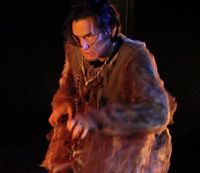
Byron Chief-Moon. Photo:  Andres SalasIhtsi-pai-tapi-yopa: Essence of Life

Byron Chief-Moon is the Coyote in this Coyote Arts Percussive Performance Association presentation of Ihtsi-pai-tapi-yopa: Essence of Life. Subtitled Explorations of a Tribal Paradigm  this Sun-dance ceremony of the Blackfoot people gives us an insight to the daily rituals of this first world nation. Three performers , one dressed as a coyote (Byron Chief-Moon), and the other two as blackbirds (Sheldon Blue-Hawk and Duane Howard).

The performance was meditative in the sense that one could feel subliminal emotions as the dancers performed their rituals t hrough song and dance. At times, the percussive music would take he audience into a trance, then it stops suddenly, as the backdrop shows us blackbirds flying in the sky, or a buffalo in rage, running, as the sound of a train whistles by. Then we see the blackbirds dancing to the hip-hop and sometimes disco music.

In the programme notes, Byron Chief-Moon explains the inerdisciplinary approach to this dance--traditional and ritualistic, combined with the contemporary modes of today's music: "Our current inter-disciplinary dance/media project is closely translated as Essence of life, echoing the root inspiration of the Blood-Kainai tribe through the intimate details of landscape.  To the tribe there is an appreciation that as long as there is honour for Mother-earth as a living soul then there is a choice, as her children, to continue to hear her stories and evolve towards becoming earth-human, for a better tribal-community, and meditations, of and on the tribal lands, reflecting a choice of freedoms which are communicated in daily activities"

For Blackfoot tribes, just as the African tribes, or the ancient tribes of Asia, there is no dichotomy between the spiritual and the material as is the case in Western Civilization and religions. Rather, the relationship is, as Byron Chief-Moon so succinctly put it, "between the natural world as conscious-earth and the conscious earth-human".

In tribal religions, it is Mother Earth that is the prime mover, and she is explored through the animals, elements, and spirits of the land.  This experience of watching this performance was indeed owerful, providing the audience with an immense connection and understanding of the cosmic relationship to Mother-earth. And again, in Byron Chief-Moon's words, "For the Blood-Kainai tribe, this is Ihtsi-pai-tapi-yopa: Essence of Life".

© 2010 Ed Farolan